TL;DR:
- Immediately stop water use, contain spills, and ventilate affected areas during a drainage emergency.
- Contact professional, vetted drainage services promptly, providing clear property and problem details.
- Post-incident, verify repairs with CCTV, document for insurance, and adopt regular maintenance to prevent future emergencies.
A blocked drain rarely announces itself politely. One moment everything is fine; the next, sewage is backing up through your ground-floor toilet, water is pooling across the kitchen floor, and your phone is ringing with complaints from tenants or staff. For property owners and managers across Greater London, a drainage emergency can escalate from inconvenience to serious structural damage within hours. This guide gives you a clear, step-by-step workflow to protect your property, stay safe, and get the right professionals on site fast, so you can move from panic to resolution with confidence.
Table of Contents
- What to do immediately: safety and containment steps
- Contacting 24/7 emergency drainage services
- On-site: the emergency drainage process explained
- After the emergency: verification, liability, and prevention
- Why prevention always beats emergency reaction
- Get rapid, reliable help for drainage emergencies
- Frequently asked questions
Key Takeaways
| Point | Details |
|---|---|
| React fast and stay safe | Immediate action and basic safety can limit property damage before help arrives. |
| Professional response is crucial | Reliable emergency drainage teams in London usually arrive within 1-2 hours and bring the right tools. |
| Costs and ownership matter | Emergencies typically cost £200–500 and it’s vital to know if you’re responsible for repairs. |
| Routine maintenance prevents chaos | Scheduling regular checks reduces your risk of emergencies by over three-quarters. |
What to do immediately: safety and containment steps
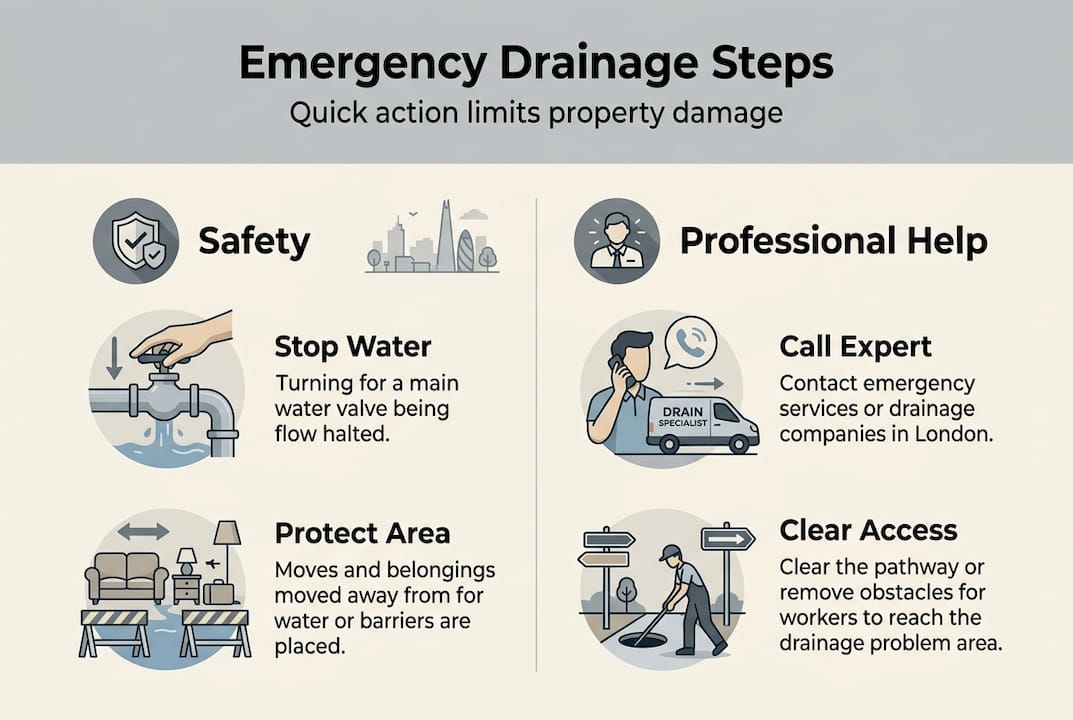
The first few minutes of a drainage emergency matter enormously. Acting quickly and correctly limits damage, protects health, and makes the professional’s job faster once they arrive. The emergency drainage steps you take right now set the tone for everything that follows.
The very first thing to do is stop using water anywhere in the affected area. That means no flushing toilets, no running taps, no dishwashers or washing machines. Every litre of water you add to a blocked system pushes the problem further and risks a larger overflow. This is non-negotiable.
Next, contain any water or sewage that has already escaped. Use towels, buckets, or plastic sheeting to prevent it spreading to carpets, skirting boards, or adjacent rooms. If sewage is present, ventilate the space immediately by opening windows and doors. Sewage gases can be harmful, and the smell alone will make the area unusable.
Check your external manholes. Lift the cover carefully and look inside. If you can see standing water or waste backed up to the top, the blockage is likely within your private drainage run. This simple check gives the engineer useful information before they even arrive. Knowing the location of the blockage speeds up diagnosis considerably. You can learn more about common emergencies and response to understand what different symptoms typically indicate.
Here is a quick checklist of what to have ready before help arrives:
- Rubber gloves and protective footwear for anyone near the affected area
- Buckets and mop to manage overflow
- Plastic sheeting or old towels to protect flooring
- Your phone with photos already taken
- Property access notes including gate codes or key locations
- Insurance policy details to hand
| Item | Purpose |
|---|---|
| Rubber gloves | Protect against sewage contact |
| Buckets | Contain overflow and reduce spread |
| Phone with camera | Document damage for insurance |
| Torch | Inspect manholes safely |
| Insurance documents | Speed up claims process |
Pro Tip: Take dated photographs of every affected area before you touch anything. These images are invaluable for insurance claims and can prevent disputes later.
Safety warning: If you suspect any electrical risk from water near sockets or fuse boards, or if you notice structural movement such as subsidence or cracking, do not attempt to investigate yourself. Evacuate the area and call emergency services immediately. Your safety takes priority over stopping the cause.
The emergency drainage workflow for property owners in Greater London typically begins with these immediate safety measures: stop using affected drains, contain water or sewage, protect the property, and check external manholes to locate the blockage.
Contacting 24/7 emergency drainage services
Once the situation is stabilised, prompt professional involvement is the next priority. The sooner you call, the sooner a qualified engineer is on their way. London’s drainage emergencies can worsen rapidly, particularly in older properties with ageing pipework.
When you call, be ready to describe the emergency clearly and concisely. Vague descriptions slow things down. Prepare the following before you dial:
- Full property address including postcode and any access instructions
- Nature of the problem such as sewage overflow, blocked toilet, or flooding
- How long it has been occurring and whether it is getting worse
- Photos ready to send via text or email if requested
- Access notes including gate codes, key safe numbers, or parking restrictions
A reputable London emergency service will typically respond within 60 to 90 minutes of your call. Response times of 1 to 2 hours are standard for 24/7 emergency drainage providers operating across the capital. Some providers, including RSJ Drains, guarantee a two-hour response as a minimum standard.
Here is what typically happens once you make that call:
- You describe the emergency and provide your address
- The call handler confirms availability and gives an estimated arrival time
- An engineer is dispatched with the appropriate equipment for your described issue
- You receive a confirmation call or message with the engineer’s details
- The engineer arrives, assesses the situation, and begins work
Not every drainage issue qualifies as an emergency, but the following situations always do: rapid sewage overflow into living or working spaces, water damage spreading to multiple rooms, flooding that cannot be contained, or any risk to electrical systems.
Pro Tip: Call a professional before attempting further DIY. A quick phone conversation with an expert can prevent you from making the blockage worse and may save you money on the final repair.
Local, reputable contractors also matter for compliance reasons. Since 2011, responsibility for private drains sits with the property owner up to the boundary. Using a qualified contractor ensures your repair is documented and defensible for insurance and legal purposes.
On-site: the emergency drainage process explained
Now that help is on the way, understanding what to expect on site keeps you in control and prepared. A good engineer will work methodically, and knowing the sequence helps you assist rather than hinder the process.
On arrival, the engineer will first check external access points such as manholes and inspection chambers. This gives them a picture of where the blockage sits within your drainage run. They may then move inside to inspect internal access points depending on the layout of your property.
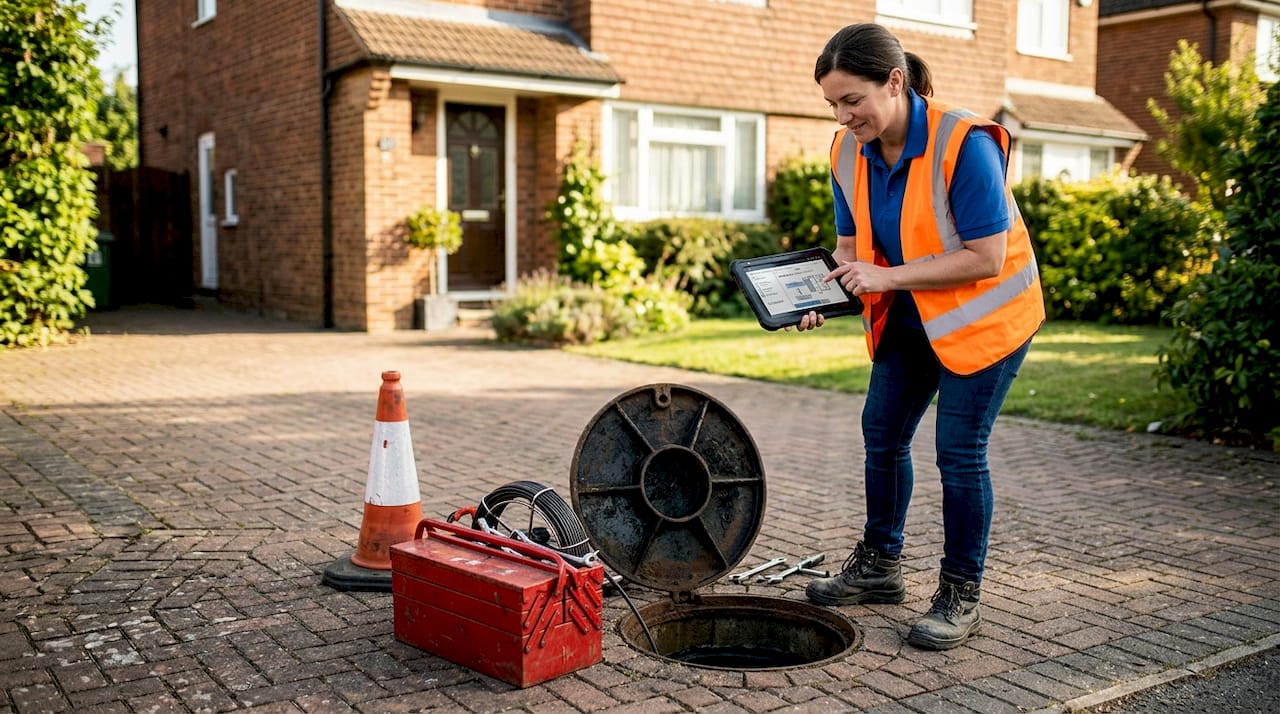
The tools used will depend on the nature and severity of the problem:
| Tool | Purpose | Typical outcome |
|---|---|---|
| CCTV camera | Locates exact blockage or damage | Accurate diagnosis first time |
| High-pressure water jetting | Clears grease, scale, and debris | Resolves most blockages in one visit |
| Mechanical rods | Breaks up solid obstructions | Effective for straightforward blockages |
| Drain relining equipment | Repairs cracked or broken pipes | Long-term fix without excavation |
The typical sequence from arrival to resolution runs as follows:
- External manhole inspection to identify blockage location
- CCTV survey if the cause is not immediately obvious
- High-pressure water jetting or mechanical rodding to clear the blockage
- Post-clearance CCTV check to confirm the pipe is clear and undamaged
- Written report provided to the property owner or manager
For access, make sure rooms are clear, pets are secured, and someone is available to answer questions throughout. The engineer may need to move between indoor and outdoor areas, so clear pathways save time. Case examples from London properties show that good access can reduce on-site time significantly.
On costs, emergency drainage repairs typically range from £200 to £500+ depending on severity, location, and the tools required. CCTV and jetting together represent the most effective combination for a first-time fix. Working with local drainage specialists who know London’s older infrastructure also reduces the risk of repeat callouts.
Pro Tip: Stay available on site or by phone throughout the visit. If the engineer has a question about previous issues or access to a particular area, a quick answer from you can mean the difference between a one-visit fix and a return appointment.
After the emergency: verification, liability, and prevention
With the emergency resolved, lasting peace of mind comes from proper verification and prevention. Do not assume the job is done simply because the water has cleared.
Ask the engineer for CCTV footage of the pipe after clearance. This gives you visual proof that the blockage is fully removed and that no structural damage was caused or left unaddressed. Run all affected drains slowly for several minutes and watch for any signs of slow drainage or gurgling, which can indicate a partial blockage remains.
Once you are satisfied the repair is complete, work through the following steps:
- Report the incident to your property management company or landlord if applicable
- Notify your insurer and submit your dated photographs and the engineer’s written report
- Document everything including the date, time, cause, repair method, and cost
- Check neighbouring properties if the blockage was in a shared run, as they may be affected too
- Review your drainage plan to understand the full layout of your private system
Understanding liability is essential. Since 2011, responsibility for private versus public sewers has been clearly defined: owners are responsible for drains within their boundary, while the water company takes over beyond it. If your blockage sits in a shared or public sewer, report it to Thames Water rather than paying for a private repair. The London maintenance explained resource covers this in practical detail.
Fact: Planned preventative maintenance reduces emergency callouts by 78%. That figure alone makes a strong case for moving from reactive to planned drainage management.
Pro Tip: Record every detail from this incident, including photographs, the engineer’s report, and your own notes. This file becomes the foundation for your planned maintenance schedule and speeds up response if the same issue recurs.
Why prevention always beats emergency reaction
Here is an uncomfortable truth: most drainage emergencies we attend in London were entirely avoidable. They were not bad luck. They were the result of deferred maintenance, ignored warning signs, and the very human tendency to deal with problems only once they become impossible to ignore.
We understand why it happens. Property management is demanding, budgets are tight, and a drain that is working feels like a low priority. But the cost of a single emergency, financial, logistical, and reputational, almost always exceeds the annual cost of a maintenance guide and routine inspection programme.
The owners and managers who handle emergencies best are not the ones who react fastest. They are the ones who have already documented their drainage layout, know their liability boundaries, and have a scheduled inspection in the diary. When something does go wrong, they have context, they have records, and they have a contractor relationship already in place.
Our view is this: treat every emergency as a signal that your planned maintenance needs updating, not as random misfortune. The drain did not fail without warning. Something was missed. Use this incident to build a better system going forward, and you will face far fewer crises in the years ahead.
Get rapid, reliable help for drainage emergencies
Having a plan is vital, but expert support ensures every emergency is handled swiftly and safely. RSJ Drains provides 24-hour emergency drainage services across Greater London, with a guaranteed response time and fully equipped engineers ready to diagnose and resolve blockages, pipe damage, and sewage issues on the first visit.
Whether you need immediate help right now or want to put a proactive maintenance plan in place, our London drainage experts are ready to assist. We offer CCTV surveys to give you a clear picture of your drainage system’s condition, as well as fast, professional blocked drain help for urgent situations. Call us any time, day or night, and we will have someone with you as quickly as possible.
Frequently asked questions
How quickly can emergency drainage teams respond in London?
Most emergency drainage teams in London arrive within 60 to 90 minutes of your call, with many providers offering a guaranteed two-hour maximum response.
What should I do first during a drainage emergency?
Stop using all water in the affected area immediately, contain any spill with towels or buckets, and call a professional for advice. The immediate safety measures you take in the first few minutes significantly limit damage.
Who is responsible for fixing a blocked drain, me or the water company?
Since 2011, property owners are responsible for private drains up to the property boundary. Beyond that point, responsibility shifts to the water company, so always confirm the blockage location before commissioning a repair.
How can I prevent future emergency drainage callouts?
Arrange planned preventative maintenance to catch issues before they escalate. Regular inspections and jetting reduce emergency incidents by 78%, making PPM one of the most cost-effective investments a property owner can make.