TL;DR:
- Drainage surveys identify underground pipe issues before they become costly problems.
- Modern CCTV inspections are non-invasive, quick, and provide detailed defect analysis.
- Regular surveys and proper interpretation protect property value and prevent costly repairs.
Most drainage problems don’t announce themselves. They build quietly beneath floors, behind walls, and underground, until one day you’re facing a flooded garden, a foul smell drifting through your property, or a repair bill that leaves you speechless. The uncomfortable truth is that waiting for visible signs before investigating your drains is one of the most expensive habits a London property owner can have. A drainage survey changes that entirely. It gives you clear, factual visibility into what’s happening inside your pipework, long before minor issues become structural ones.
Table of Contents
- What is a drainage survey and when is it needed?
- How do CCTV drainage surveys work?
- Standards and codes: Making sense of drainage survey reports
- Applying survey insights: Maintenance, repairs, and value protection
- What most owners miss about drainage surveys
- Get expert drainage insights and protect your property
- Frequently asked questions
Key Takeaways
| Point | Details |
|---|---|
| Early detection saves money | Identifying blockages or pipe defects before they escalate can prevent costly emergencies and repairs. |
| CCTV surveys are non-invasive | Modern camera technology checks drains thoroughly without digging up your property. |
| Survey codes have real meaning | Understanding condition grades empowers you to prioritise repairs or plan maintenance intelligently. |
| Expertise affects accuracy | Survey outcomes depend on both camera quality and operator experience, not just technology. |
What is a drainage survey and when is it needed?
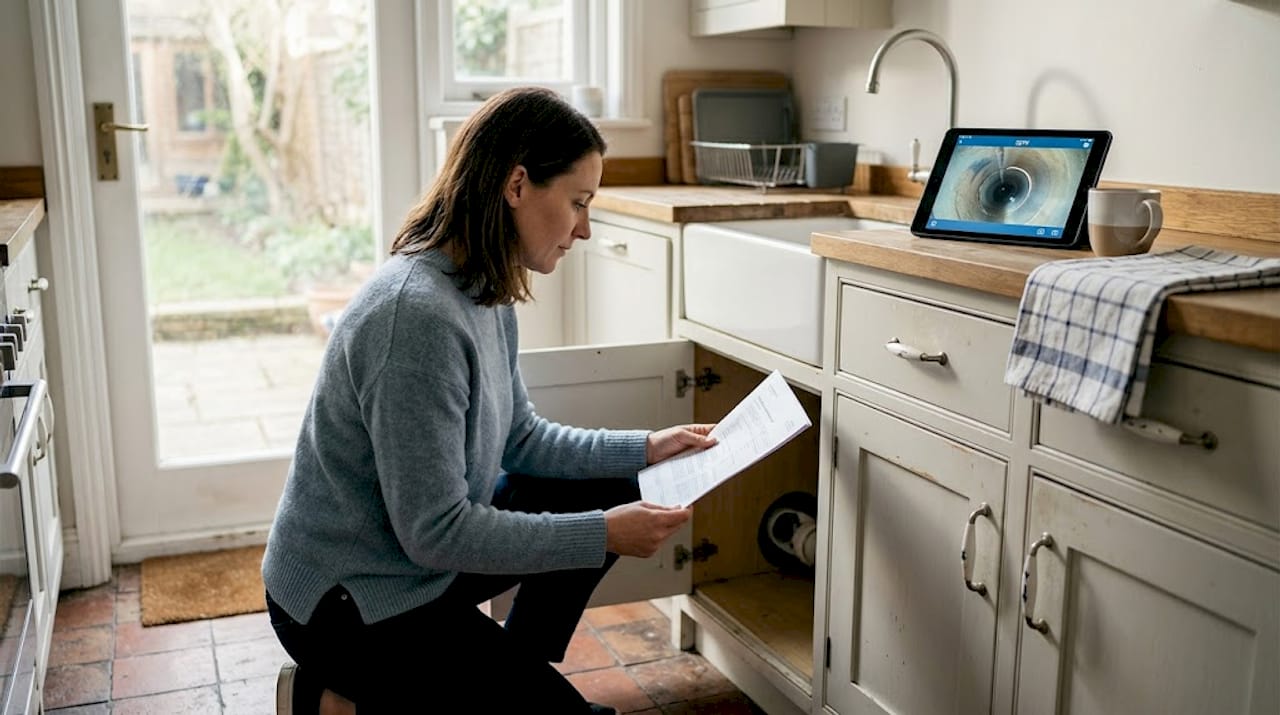
A drainage survey is a professional assessment of your property’s underground drainage system. Its purpose is straightforward: to identify what condition your pipes, gullies, and junctions are in, and to flag anything that could cause problems now or in the near future. Rather than relying on guesswork or waiting for a blockage to become obvious, surveys give you documented evidence of your drainage system’s health.
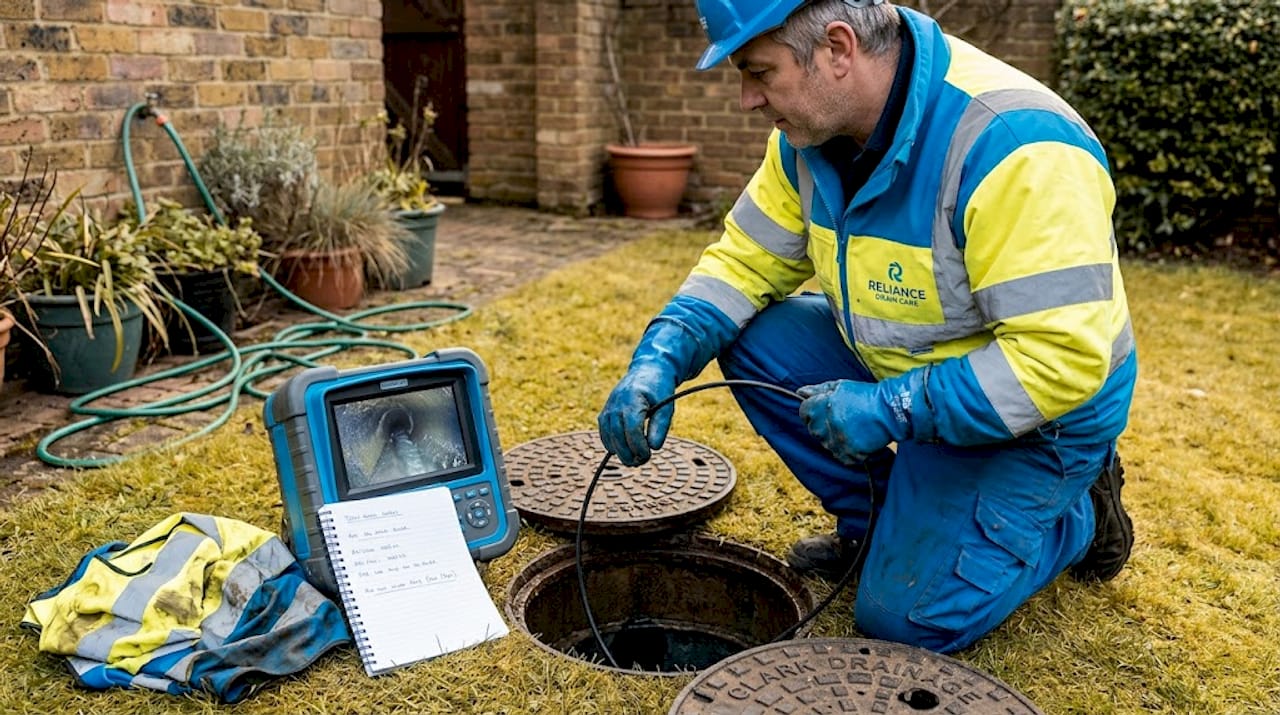
The most widely used method today is the CCTV drainage survey, where a small waterproof camera mounted on a flexible rod is fed into the pipework. The camera transmits live footage to a screen, which a trained operator watches in real time. Other methods exist too. Smoke testing involves pumping harmless smoke into the pipes to reveal cracks or poorly sealed joints by watching where it escapes. Dye testing traces the flow path of water using coloured dye, particularly useful for confirming which drains connect where. Each method serves a slightly different purpose, and experienced drainage engineers will often recommend the most appropriate approach for your specific situation.
Common reasons to commission a drainage survey include:
- Recurring blockages that keep returning despite repeated clearing
- Pre-purchase checks when buying a property, to avoid inheriting drainage problems
- Planning applications where building regulations require proof of existing drainage condition
- After tree removal or new planting, as root intrusion is a frequent and under-reported cause of damage
- Unexplained damp, subsidence, or ground movement around the property
- Routine preventative checks to satisfy insurance requirements or maintain commercial premises
Understanding drain inspection importance is especially relevant in London, where ageing Victorian infrastructure runs beneath many residential streets and properties. The growing demand for CCTV surveys across the UK reflects a shift toward non-invasive inspections and no-dig repairs, and industry guidance recommends scheduling a survey every 18 to 22 months for most sewers. You can read more about the broader context of drainage surveys for property owners to understand the full scope of what these assessments cover.
Pro Tip: If you’re purchasing a property in London, always request a drainage survey as part of your due diligence, even if the seller says the drains are “fine.” Issues found post-completion are entirely your responsibility.
The non-invasive nature of modern surveys is one of their most practical advantages. There’s no digging, no breaking up of patios or flooring, and no prolonged disruption to your day. A typical residential survey takes between one and three hours and leaves your property exactly as the engineer found it.
How do CCTV drainage surveys work?
Now that you know why and when a survey is needed, let’s break down what actually happens when a professional arrives with a camera unit.
The process follows a reliable sequence, and knowing each step helps you understand the value of what you’re paying for.
- Initial access point identification. The engineer locates your drainage inspection chambers, rodding eyes, or other access points. On older London properties, these may not be where you’d expect them.
- Pre-survey high-pressure jetting (where needed). If the pipes contain significant debris or built-up grease, they’ll be cleaned first. This is important. A camera can’t accurately assess a pipe it can’t see clearly through.
- Camera insertion and live feed monitoring. The camera is fed through the access point and pushed through the pipe length. Modern rigs use HD pan-tilt-zoom (PTZ) cameras that can rotate to inspect pipe joints, look upstream and downstream simultaneously, and zoom into fine cracks.
- Real-time defect coding. As the camera moves, the operator identifies and codes defects live, using recognised classification systems (more on that shortly).
- Distance recording. The camera rig automatically logs the distance travelled, so every defect is mapped to a precise location in the pipe.
- Report generation. After the survey, a full written report is produced, including annotated footage stills, defect codes, locations, and recommended actions.
Here’s how modern CCTV equipment compares to older alternatives:
| Feature | Modern HD PTZ camera | Older standard camera |
|---|---|---|
| Image quality | High-definition, colour | Lower resolution, often grainy |
| Viewing angle | 360° pan-tilt-zoom | Fixed forward-facing only |
| Defect detection accuracy | High, including hairline cracks | Limited to obvious damage |
| Report output | Digital video with timestamps | Often VHS or basic DVD |
| AI-assisted coding | Available on premium rigs | Not available |
The technology matters, but it’s only part of the picture. Accuracy in drain camera inspections depends heavily on operator experience. A skilled operator must interpret footage with genuine expertise, since AI-assisted coding is emerging but still requires human verification for reliable results. The camera sees what it sees. The engineer makes the call.
The benefits of a CCTV drain survey are most fully realised when the reporting is transparent. A reputable surveyor will document any limitations: sections of pipe that couldn’t be accessed, areas obscured by standing water, or sections where the camera simply couldn’t reach. If a report doesn’t acknowledge limitations, treat that as a warning sign.
Pro Tip: Always ask your drainage surveyor whether the pipes were cleaned before the camera was inserted. A survey carried out in heavily silted or grease-coated pipes is significantly less reliable, regardless of camera quality.
Standards and codes: Making sense of drainage survey reports
Understanding how surveys are performed sets the stage for interpreting the results. Here’s how to decode those technical reports and what the ratings truly mean.
When you receive a drainage survey report, it will contain codes that initially look like a foreign language. In practice, the UK uses two main standards to ensure consistency across surveys:
- WRc MSCC5 (Manual of Sewer Condition Classification, 5th edition): The primary UK coding system for identifying and describing pipe defects
- EN 13508-2: The European standard for describing the condition of drain and sewer systems, used alongside MSCC5 for descriptive coding
These standards for drain coding are what underpin every reputable drainage report in the UK. Without them, reports from different companies would be impossible to compare.
Common defect codes you might see in a report include:
| Code | What it means | Typical cause |
|---|---|---|
| RM | Roots mass | Tree roots penetrating the pipe |
| CC | Circumferential crack | Ground movement or age-related stress |
| FB | Fracture, broken | Impact or significant ground subsidence |
| DAF | Debris attached fine | Grease or fine sediment coating the pipe |
| OB | Open joint | Seal failure between pipe sections |
| DI | Displaced invert | Pipe sections misaligned at their base |
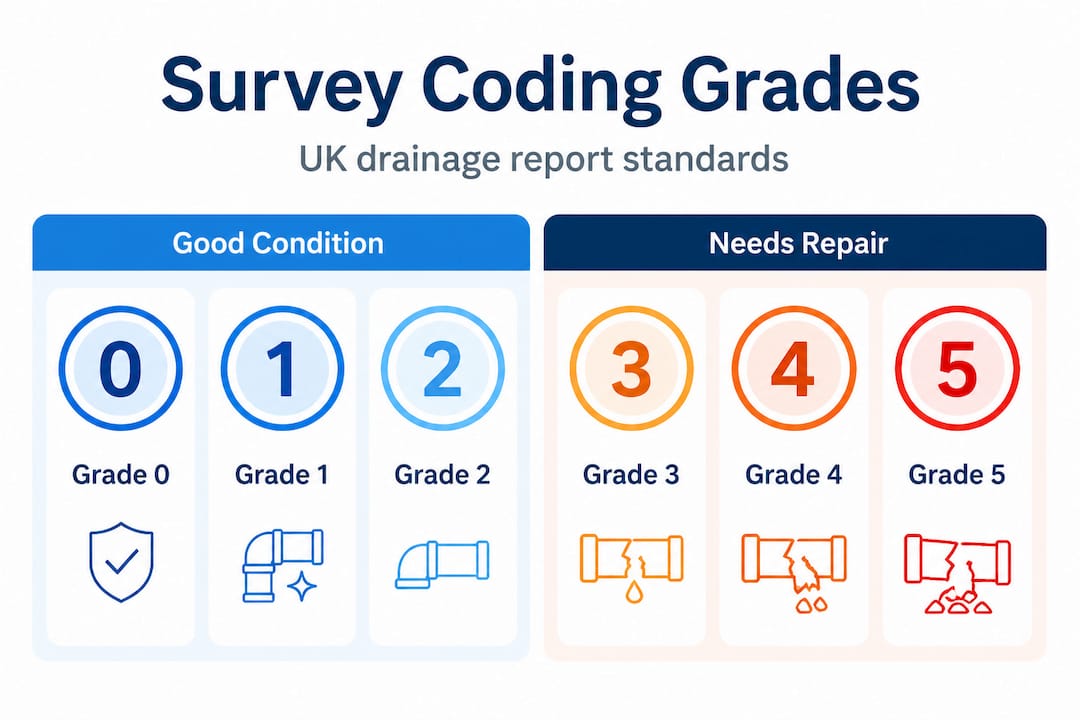
Alongside these codes, reports assign a condition grade on a scale of 1 to 5:
Grade 1 indicates a minor defect with no immediate action required. Grade 5 means the pipe is at or near imminent structural collapse and requires urgent intervention.
Most properties in London with ageing infrastructure will have pipes rated anywhere from grade 2 to grade 3, representing manageable defects that benefit from planned maintenance. A grade 4 or 5 rating demands prompt action. Ignoring it doesn’t make the pipe stronger.
Understanding the value of routine inspections becomes much clearer when you can read a report and understand what you’re looking at. A grade 2 root intrusion spotted today might cost a few hundred pounds to address with precision jetting. Left for two or three years, the same roots can fracture the pipe entirely, turning a manageable maintenance job into a full excavation.
The role of a well-documented report extends beyond immediate repairs. If you ever sell your property, or make an insurance claim related to drainage, having a series of dated, standardised reports is genuinely valuable evidence.
Applying survey insights: Maintenance, repairs, and value protection
Having deciphered survey reports, it’s time to see how owners can turn knowledge into tangible benefits for their properties.
Survey findings are most useful when they lead directly to targeted action. Here’s a logical sequence for moving from report to results:
- Prioritise by condition grade. Address grade 4 and 5 defects first. Grade 2 and 3 defects can often be scheduled into a planned maintenance programme.
- Match the repair method to the defect. Root intrusion is typically resolved with high-pressure water jetting followed by CCTV confirmation. Cracked or displaced pipes may be suitable for drain relining, which repairs the pipe from within without excavation.
- Create a maintenance calendar. Use the survey report as a baseline. Schedule your next survey within the recommended 18 to 22 month window to track whether conditions are improving, stable, or worsening.
- Document everything. Keep copies of every survey report, every repair invoice, and every maintenance visit. This paper trail is valuable for insurance, planning applications, and future property sales.
- Communicate with neighbours or managing agents. In terraced properties, flats, or commercial estates, shared drainage is common. One owner’s blocked lateral pipe can cause flooding in an adjacent property.
The financial logic of planned drain maintenance is straightforward. Emergency callouts in London typically cost significantly more than routine visits, and that’s before factoring in any damage caused while you waited. A mid-range CCTV survey is a small investment compared to the cost of replacing a collapsed drain beneath a driveway or garden.
Pro Tip: If your property has mature trees nearby, factor in annual inspections rather than waiting the full 22 months. Root growth accelerates during dry summers when trees search deeper for water, and London’s clay-heavy soil makes roots particularly aggressive.
Well-maintained, documented drainage also adds quiet credibility to a property during sale negotiations. A buyer’s surveyor who discovers no drainage concerns, and who is handed reports proving regular professional upkeep, is far less likely to recommend a price reduction on drainage grounds.
What most owners miss about drainage surveys
Here’s the part that rarely makes it into standard advice articles, and it’s worth being direct about it.
The most common mistake property owners make isn’t failing to book a drainage survey at all. It’s treating the survey as a one-time action rather than a recurring part of property management. We see this pattern regularly. An owner experiences a blockage, books a survey, gets the report, fixes the specific problem identified, and then forgets about the drains entirely until the next crisis arrives. That’s not a maintenance strategy. That’s reactive firefighting with an expensive time delay between each fire.
What genuinely smart property management looks like is building drainage surveys into the same annual or biannual cycle as gas safety checks and boiler services. The drainage system beneath your property isn’t static. It ages, shifts with ground movement, accumulates debris, and is affected by root growth, weather events, and what goes down your sinks. A single snapshot from three years ago tells you very little about today’s condition.
There’s also a widespread misconception that expensive equipment alone guarantees a quality survey. We’ve reviewed reports produced with top-of-the-range camera rigs that missed obvious defects because the operator lacked the experience to interpret what the footage showed. Conversely, we’ve seen thorough, honest reports produced with modest equipment by engineers who genuinely knew what they were looking at. When selecting a drainage surveyor, ask how long their engineers have been conducting surveys, not just what cameras they use.
Finally, many owners fail to request or retain a copy of the survey’s limitation statements. Every professional report should include a section detailing what couldn’t be assessed and why. This protects you as much as it protects the surveyor. If a section of pipe is flooded with groundwater and the camera can’t pass through it, that should be clearly documented. Without that record, you might assume the pipes were fully assessed when they weren’t. Always request this CCTV survey documentation and keep it alongside your repair records.
The owners who get the most value from drainage surveys are those who treat the report not as a final verdict but as an ongoing conversation with their property.
Get expert drainage insights and protect your property
If this guide has made one thing clear, it’s that drainage surveys are most valuable when they’re carried out regularly, interpreted correctly, and followed up with targeted action.
RSJ Drains provides professional CCTV drainage surveys across Greater London, carried out by experienced engineers who deliver clear, honest reports you can actually use. Whether you need a survey for a pre-purchase check, a routine inspection, or to investigate a recurring problem, the process is straightforward, non-invasive, and documented in full. You can also explore all drainage services including high-pressure jetting, drain relining, and emergency callouts, or browse drain maintenance guidance for London homes to plan your next steps with confidence. Don’t wait for a crisis to find out what’s happening beneath your property.
Frequently asked questions
How often should a property have a drainage survey?
For UK properties, a CCTV drainage survey is recommended every 18 to 22 months, or before major works or property transactions. Properties with mature trees nearby or older pipework may benefit from more frequent checks.
What problems can a drainage survey detect?
A survey can reveal blockages, cracks, root intrusion, collapsed pipes, and early signs of drainage failure invisible from the surface. Using WRc MSCC5 defect codes such as RM for root mass and CC for circumferential cracks, engineers can pinpoint and document exactly what they find.
Is a CCTV drainage survey disruptive?
CCTV surveys are non-invasive and require no digging, causing minimal disruption to your property. Most residential surveys are completed within one to three hours.
Are drainage survey standards the same across the UK?
Yes, most reputable surveys comply with WRc MSCC5 and EN 13508-2 for consistency and reliability in defect coding and reporting, ensuring reports from different companies can be meaningfully compared.