
TL;DR:
- Drain survey reports reveal hidden defects crucial for maintenance and property value protection in London.
- Understanding coding standards like EN 13508-2 and MSCC5 is key to interpreting defects accurately.
- Combining codes with visual evidence and professional guidance ensures effective drainage management.
You receive a thick drain survey report after a CCTV inspection, open it up, and immediately see a wall of codes like BAA, CC, RM, and condition grades from 1 to 5. For most property owners and managers in Greater London, this is an all-too-familiar moment of confusion. That report represents real, actionable intelligence about the condition of your drainage system, and yet it might as well be written in a foreign language. This guide cuts through the jargon, explains the major coding standards, and shows you exactly how to turn those baffling codes into smart maintenance decisions.
Table of Contents
- Why drain survey reports matter for London property owners
- The main coding standards: EN 13508-2 and MSCC5 explained
- Common defect codes and what they mean for your property
- Turning reports into action: smarter drain maintenance
- A clearer perspective: what most drain survey reports miss
- Next steps: get expert drainage help in Greater London
- Frequently asked questions
Key Takeaways
| Point | Details |
|---|---|
| Decode with context | Drain survey codes are only meaningful when you understand the standards and local context. |
| Use reports for planning | Well-interpreted reports help you set proactive maintenance priorities and budgets. |
| Combine tech with expertise | AI speeds up reporting, but human insight is needed for truly reliable decisions. |
| Demand plain English | Always seek clear, jargon-free explanations alongside technical codes in your report. |
Why drain survey reports matter for London property owners
A drain survey report is not simply a piece of paperwork. It is one of the most accurate pictures you will ever get of what is happening beneath your property, and what might be quietly developing into an expensive problem. London’s drainage network is old, complex, and under constant pressure from tree roots, ground movement, and decades of use. The consequences of ignoring early warning signs can be severe: collapsed drains, sewer flooding, and costly emergency repairs.
Understanding why drain inspections matter is the first step. Survey reports reveal hidden or developing defects before they escalate. They also provide the hard evidence insurers, solicitors, and local authorities often require during property transactions or compliance checks.
Here is what a well-interpreted report can do for you:
- Identify structural defects such as cracks, deformation, and joint displacement that could lead to collapse
- Highlight operational defects like root ingress, grease build-up, and sediment deposits that restrict flow
- Assign priority ratings so you know which issues need immediate attention and which can be monitored
- Provide a documented maintenance history that actively supports drain maintenance and property value over the long term
A key distinction to understand early: Defects are coded using standards like BS EN 13508-2, which uses descriptive codes such as BA for structural defects (for example BAA for deformation) and BB for operational defects (for example BBA for roots). The UK-specific WRc MSCC5 standard adds condition grades from 1 to 5 and codes like RM for roots mass and CC for circumferential crack. Knowing which standard your report uses changes how you read every single entry.
Accurate reports are also increasingly important for commercial property portfolios, where proactive maintenance scheduling can mean the difference between planned expenditure and unplanned emergencies.
The main coding standards: EN 13508-2 and MSCC5 explained
There are two major standards you will encounter in Greater London drain survey reports. Understanding them both is essential because they look similar on the surface but work quite differently in practice.
EN 13508-2 is a European standard that provides a structured system of descriptive codes for recording the condition of drainage systems. Importantly, EN 13508-2 provides descriptive coding without grading, which means it tells you what type of defect has been found but does not tell you how severe it is. Severity assessment is left to individual countries to define through their own supplementary standards. This makes EN 13508-2 consistent across borders but also means it requires professional training to interpret accurately, since characterisations can vary depending on which country-specific overlay is applied.
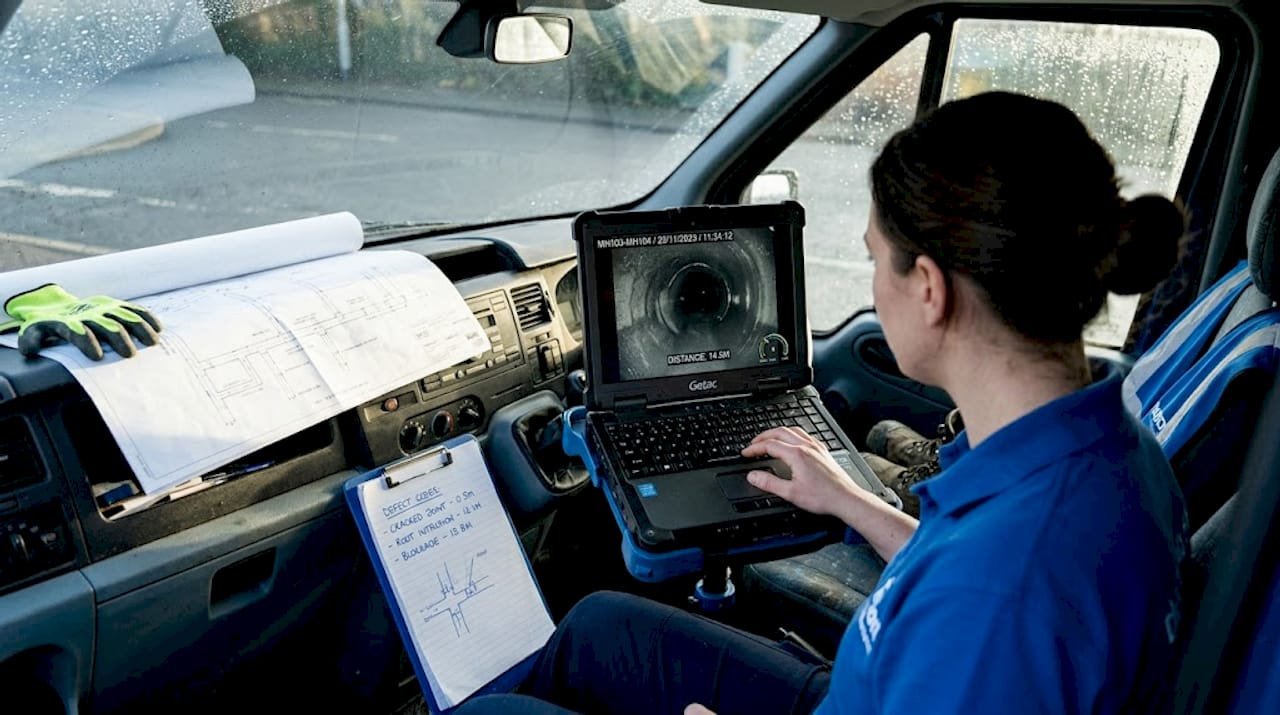
MSCC5 (the Manual of Sewer Condition Classification, 5th edition) is the UK gold standard. It is built on top of EN 13508-2 but adds condition grades and is widely integrated in software like iTouch and WinCan. The MSCC5 standard also features dual grading systems, which can cause confusion even for experienced professionals. There is the DRB (Drainage Risk to Building) scale running from A to C, and the SRM (Sewer Risk Management) scale running from 1 to 5. These serve different purposes and should never be conflated.
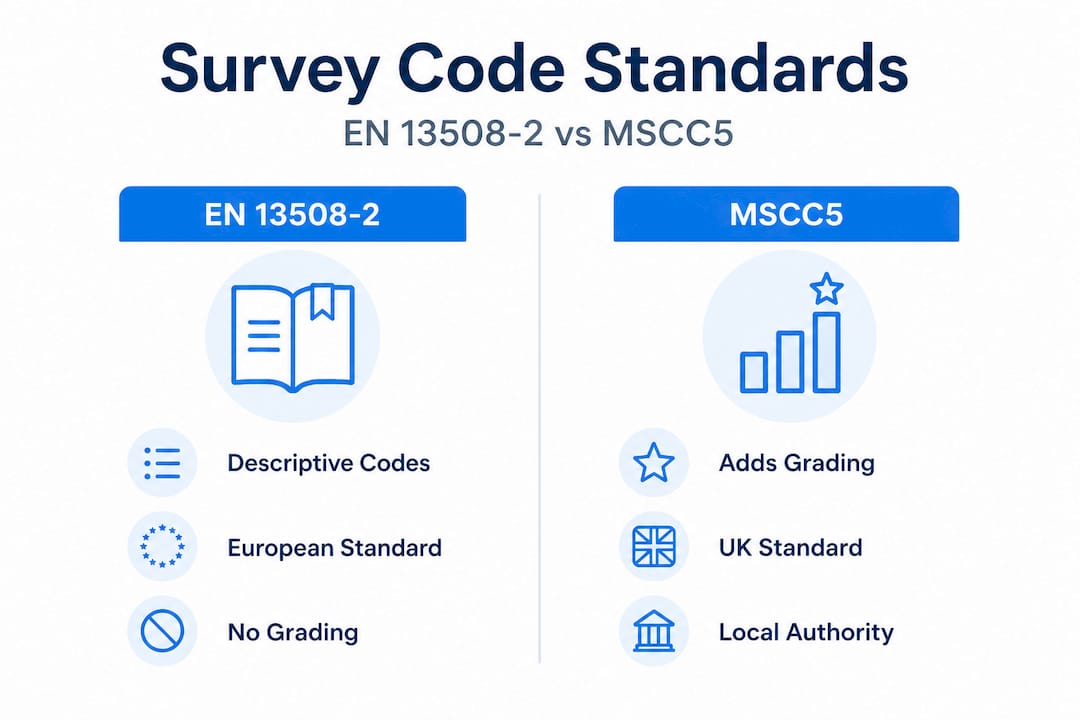
Here is a quick comparison to make this clearer:
| Feature | EN 13508-2 | MSCC5 |
|---|---|---|
| Origin | European standard | UK-specific (WRc) |
| Condition grading | None | Yes (grades 1 to 5) |
| Defect coding | Yes (BA, BB series) | Yes (RM, CC, and others) |
| Software integration | Variable | iTouch, WinCan |
| Dual grading system | No | Yes (DRB A–C and SRM 1–5) |
| Used in property transactions | Occasionally | Widely in UK |
To read an MSCC5 report in practice, follow these steps:
- Locate the standard declaration on the cover page to confirm which coding system applies
- Find the defect code column, typically listed alongside chainage (distance along the drain from a reference point)
- Cross-reference the code with the MSCC5 code list to identify the defect type
- Check the condition grade assigned to each defect
- Read the accompanying remarks or narrative, which should clarify context
For drainage compliance standards relevant to London properties, MSCC5 is the format most commonly requested by local authorities and housing associations.
Pro Tip: Always check the cover page or appendix of your report to confirm which standard applies. If your report lists grades using letters (A, B, C) it is using DRB scoring. If it lists numbers (1 to 5) it is using SRM. Mixing them up leads to very different conclusions about urgency.
For a deeper look at what these codes mean in a drain inspection in London explained, the difference between standards becomes even clearer when you look at real defect codes side by side.
Common defect codes and what they mean for your property
Once you know which standard you are working with, the codes themselves become much more readable. The EN 13508-2 sewer coding standards split defects into two main families: BA codes for structural defects and BB codes for operational defects. Here is what you will see most often on a London property survey.
| Code | Type | Meaning | Typical risk level |
|---|---|---|---|
| BAA | Structural | Deformation of pipe | Moderate to high |
| BAB | Structural | Fracture | High |
| CC | Structural | Circumferential crack | Moderate |
| RM | Operational | Roots mass | Moderate |
| BBA | Operational | Root ingress | Low to moderate |
| DEF | Operational | Deposits (silt/grease) | Low |
| JD | Structural | Joint displacement | Moderate to high |
Understanding the condition grades is equally important:
- Grade 1: Good condition. No significant defect. No action required in the short term.
- Grade 2: Fair condition. Minor defects present. Monitor and include in routine maintenance schedule.
- Grade 3: Defects noted. Action should be planned but is not necessarily urgent. Assessment of context is critical here.
- Grade 4: Significant defects. Prompt action recommended to prevent deterioration.
- Grade 5: Severe defects or failure. Immediate action required to prevent collapse, flooding, or health hazard.
The most common issues London surveyors find are root ingress (particularly in Victorian-era clay pipe systems near mature trees), longitudinal and circumferential cracking, and joint displacement caused by ground movement. For a fuller breakdown of drainage industry terms that appear in reports, a reference glossary helps enormously.
Pro Tip: A Grade 3 code for root ingress 25 metres from your property boundary on a shared sewer carries very different implications from a Grade 3 crack directly beneath your kitchen floor. Location, pipe material, and drainage history all shape the real-world risk. Never read a code in isolation.
Different drain inspection methods also influence the level of detail in a report. A full CCTV survey with pan-and-tilt camera will capture far more granular data than a basic push-rod camera. If your report feels thin on detail, it may be worth considering an upgraded survey method. For a broader view of understanding drainage surveys, the method of inspection matters almost as much as the interpretation.
Turning reports into action: smarter drain maintenance
Knowing what the codes mean is only half the job. The real value comes from using that information to build a practical, cost-effective maintenance strategy. Here is a step-by-step approach that works well for both residential landlords and commercial property managers across Greater London.
- Triage by grade: Start with any Grade 4 or 5 defects. These need immediate professional assessment. Do not delay.
- Map defect locations: Plot defects against your site plan. Clusters often indicate a root cause such as a failing joint, a tree root source, or a structural problem in one section.
- Separate structural from operational: Operational defects like blockages and root ingress can often be resolved with jetting or root cutting. Structural defects like cracks and deformation may require relining or excavation.
- Schedule Grade 2 and 3 items: Build these into a residential drain maintenance programme. A six-monthly or annual inspection cycle allows you to track whether these defects are worsening.
- Request a re-survey after works: After any significant repair, commission a follow-up CCTV survey to confirm the issue has been fully resolved and to update your records.
One of the most significant developments reshaping how reports are produced is the rise of AI-assisted coding. AI-assisted coding can speed up reporting by up to 50%, reducing errors and increasing consistency, particularly for large commercial portfolios where dozens of drains may need surveying at once. Software such as WinCan VX can automatically identify and code defects from CCTV footage. However, human verification remains essential. Automated systems can misclassify unusual defects or miss context-dependent nuances that an experienced drainage surveyor would catch immediately.
Key insight: For a portfolio of ten or more properties, AI-assisted reporting can dramatically reduce the time between survey and actionable maintenance plan. For a single residential property, the priority should still be an experienced surveyor who can offer a plain-English debrief alongside the coded report.
Use your drainage problem checklist to cross-reference report findings against visible symptoms. If a Grade 3 crack corresponds to an area where you have already noticed slow drainage or damp patches, that combination elevates the priority even if the grade alone would not demand immediate action. Knowing how to identify drain problems from surface signs helps you validate what your report is telling you underground.
A clearer perspective: what most drain survey reports miss
Here is an uncomfortable truth about drain survey reports that rarely gets said plainly: a well-coded report can still leave you completely unprepared for what needs to happen next. The codes are a starting point, not a conclusion.
Many property owners and managers treat the condition grade as if it were a prescription. They see a Grade 3 and assume they need to spend money immediately. In reality, a Grade 3 assigned to a hairline crack in a concrete pipe that has been stable for fifteen years may warrant nothing more than a note in your maintenance log. Meanwhile, a Grade 2 operational defect in a high-flow commercial drain serving a restaurant could rapidly worsen and cause a blockage within weeks. Context is everything, and context is exactly what codes cannot provide on their own.
This is why visual evidence matters so much. Photos and video footage from a CCTV survey should accompany every report. Clear drainage insights come not just from what is coded but from what is shown. If your surveyor cannot provide timestamped footage alongside the written report, ask for it specifically. A code without an image is an opinion without evidence.
There is also a significant gap in how most reports handle location-specific risk. A circumferential crack near a road with heavy vehicle traffic, or a joint displacement close to a large oak tree, carries far higher urgency than the same code in a sheltered, low-traffic location. Most reports do not address this contextual risk unless the surveyor specifically includes a narrative section. Always ask your drainage specialist to walk you through the findings verbally and to flag anything that the codes alone do not adequately communicate.
The EN 13508-2 coding standard is designed to ensure consistency across assessors, but consistency does not equal completeness. A report that is perfectly coded but lacks professional interpretation is a report that has done only half its job. Insist on plain-English explanations. Ask your surveyor what they would do if it were their property. That question alone will often reveal far more than the grade column ever could.
Next steps: get expert drainage help in Greater London
Making sense of drain survey reports does not have to feel like decoding a technical manual on your own.
RSJ Drains provides specialist CCTV drain survey services across Greater London, delivering detailed, clearly explained reports that property owners and managers can actually act on. Our experienced team does not just hand you a list of codes. We walk you through the findings, explain the risk in plain terms, and help you plan the most cost-effective course of action. Whether you need a pre-purchase survey, a routine inspection, or an urgent assessment, our drain inspection professionals are available 24 hours a day with a guaranteed two-hour response. For a full overview of what good drainage stewardship looks like over the long term, our drain maintenance guide is an excellent place to start.
Frequently asked questions
What is the difference between EN 13508-2 and MSCC5 in drain survey reports?
EN 13508-2 provides descriptive coding without grading, meaning it identifies defect types but leaves severity assessment to country-specific frameworks, while MSCC5 is the UK-specific standard that assigns condition grades alongside codes for a more complete picture of drain health.
How do I know if a defect code means urgent action is needed?
Condition grades 4 and 5 indicate high-risk structural or operational issues that require prompt professional attention, but a drainage specialist should always review location, pipe material, and drainage history before a final recommendation is made.
Are AI-generated drain reports as reliable as traditional reports?
AI-assisted coding speeds reporting by 50% and improves consistency across large portfolios, but human expert verification is still essential to catch context-dependent defects and provide an accurate interpretation of findings.
What should I ask my surveyor to clarify if a report seems unclear?
Ask for plain-English explanations for each defect code and grade, and request photos or timestamped video footage to accompany the written assessment, so you can see exactly what the camera recorded rather than relying solely on coded data.