TL;DR:
- Understanding drainage terminology enables property owners to make informed repair decisions and avoid unnecessary costs.
- Knowledge of SuDS versus traditional drainage helps in compliance, flood prevention, and long-term maintenance planning.
- Clear communication with professionals, including decoding reports and defect codes, is essential for effective property management.
When a drainage engineer hands you a survey report full of terms like “invert level”, “foul sewer”, and “EN 13508-2 defect codes”, it is easy to feel completely lost. Many London property owners and managers face this exact situation, nodding along while privately unsure what any of it means. That confusion is not just frustrating; it can lead to poor decisions, unnecessary repair costs, and compliance problems. Understanding the language your drainage contractor uses puts you firmly in control. This guide walks through the most important drainage terms, explains how they appear in real reports, and shows you how knowing them can protect both your property and your budget.
Table of Contents
- Why drainage terminology matters
- Essential drainage terms every property owner should know
- Sustainable Drainage Systems (SuDS) vs traditional drainage
- Understanding reports: Codes, surveys and decision-making
- A property manager’s perspective: What most homeowners miss in drainage terminology
- Get expert help decoding your drainage reports
- Frequently asked questions
Key Takeaways
| Point | Details |
|---|---|
| Essential terms clarified | Understanding basic drainage terms makes reports and quotes far more useful. |
| SuDS are the modern standard | Sustainable Drainage Systems are replacing old pipe networks, cutting flood risk and often saving money. |
| Survey codes matter | Knowing how code systems like EN 13508-2 work helps you prioritise and understand repairs. |
| Good communication saves money | Clear dialogue with contractors based on shared terms reduces miscommunication and costs. |
Why drainage terminology matters
Drainage professionals use a precise vocabulary for good reason. Every term in a survey report or repair quote refers to something specific, and using the wrong word can mean the difference between fixing the right problem and paying for work you did not need. For property owners and managers in Greater London, this is not an abstract concern.
Think about what happens when a contractor tells you there is a “root intrusion at the junction of the foul lateral”. Without knowing what those words mean, you cannot judge whether the quoted repair is reasonable, urgent, or even necessary. You are essentially making a financial decision blind. Understanding what a drainage system is gives you the foundation to ask the right questions before signing anything.
Here are the main reasons why drainage terminology matters in practice:
- Compliance and regulation: London has specific rules around drainage, particularly for new builds and major renovations. Terms like SuDS (Sustainable Drainage Systems) appear in planning conditions, and misunderstanding them can lead to non-compliance.
- Informed repair decisions: Knowing whether a defect is structural or operational tells you whether you need emergency action or routine maintenance.
- Accurate quotes: When you understand what a contractor is describing, you can compare quotes fairly and avoid paying for unnecessary extras.
- Communication with engineers: Shared vocabulary means faster, clearer conversations with drainage professionals, saving time and reducing errors.
“SuDS manage runoff at source and are now preferred over traditional systems.” This shift in regulatory preference has real implications for London property owners dealing with planning applications or major drainage upgrades.
London’s ageing sewer network, combined with increasing rainfall intensity and urban development pressure, makes drainage knowledge even more relevant here than in many other parts of the country. Flooding events in areas like Lewisham, Hammersmith, and Barking have highlighted just how much the city’s drainage infrastructure is under stress. Staying informed about drain maintenance for London properties is not optional for responsible property management.
Pro Tip: Keep a simple glossary document with drainage terms relevant to your property type. When a new report arrives, cross-reference it before your first conversation with the contractor. You will ask sharper questions and get clearer answers.
Essential drainage terms every property owner should know
Let us go through the terms you are most likely to encounter in inspection reports, planning documents, and repair quotes. These are not exhaustive definitions; they are practical explanations designed to help you act on information.
Foul water: Wastewater from toilets, sinks, and appliances. This goes to the sewage treatment works, not a soakaway or watercourse.
Surface water: Rainwater runoff from roofs, driveways, and paved areas. In many London properties, this runs to a separate surface water sewer or soakaway, not the foul sewer.
Combined sewer: A single pipe carrying both foul and surface water. Many older London properties connect to combined sewers, which can cause problems during heavy rain when the system becomes overloaded.
Invert level: The lowest point of a pipe’s internal diameter, measured from a fixed datum. Engineers use invert levels to calculate gradients and assess whether water will flow correctly through a system.
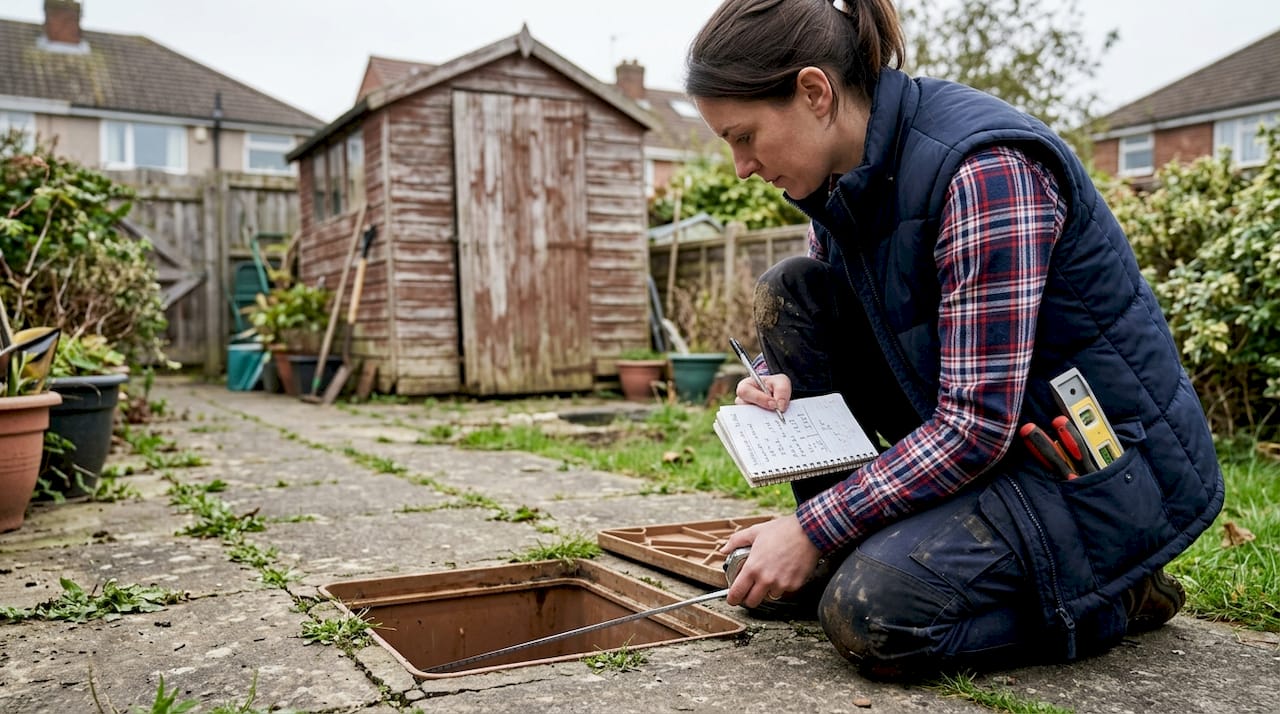
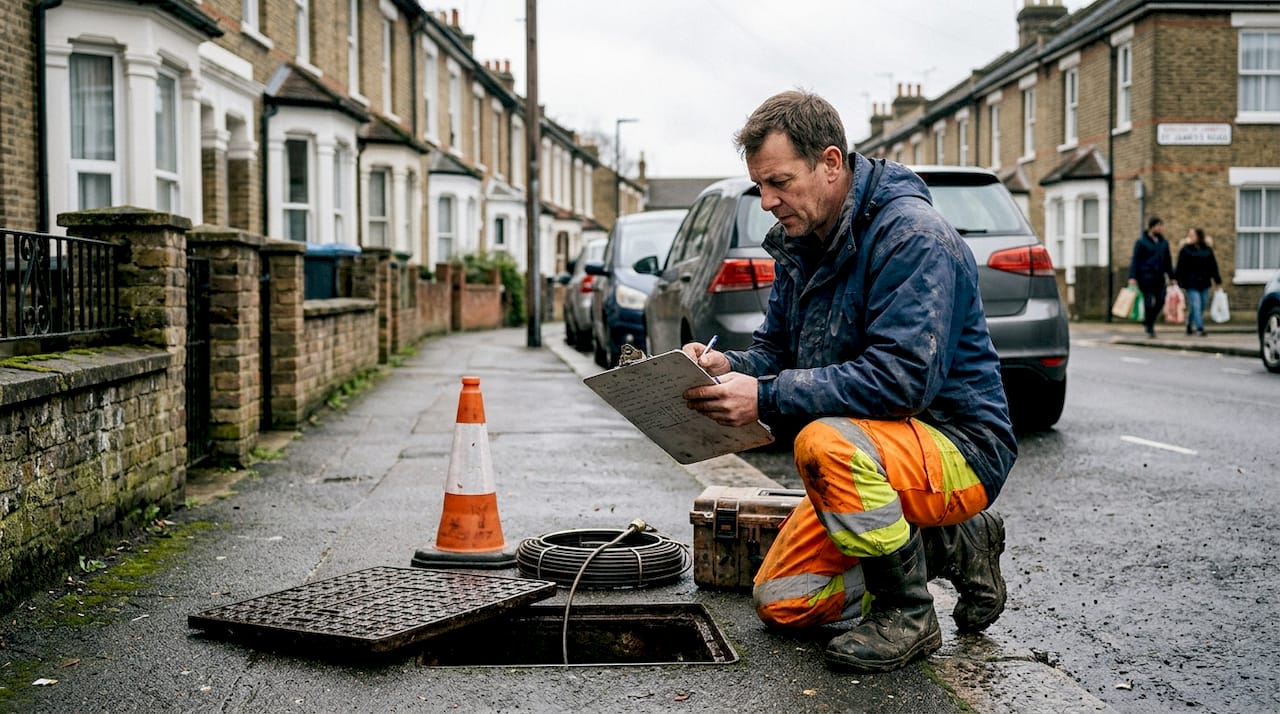
Manhole: An access chamber that allows inspection and maintenance of underground pipes. These are not just covers in the ground; they are critical inspection points.
Gully: A surface drainage inlet, typically found in yards, driveways, or at the base of downpipes. Gullies can become blocked with leaves and debris, causing localised flooding.
Soakaway: A pit filled with rubble or a purpose-built crate system that allows surface water to drain gradually into the surrounding ground. Common in gardens and driveways.
CCTV survey: A camera inspection of underground pipes. This is the standard method for diagnosing blockages, cracks, root intrusion, and other defects without excavation.
Drain relining: A repair method where a resin-impregnated liner is inserted into a damaged pipe and cured in place, restoring structural integrity without digging up the ground.
Here is a quick reference table to help you match industry language to plain English:
| Industry term | Plain-English meaning |
|---|---|
| Foul drain | Pipe carrying sewage and household waste water |
| Surface water drain | Pipe carrying rainwater runoff |
| Invert level | Lowest internal point of a pipe |
| Combined sewer | Single pipe for both sewage and rainwater |
| Soakaway | Underground pit absorbing rainwater into soil |
| CCTV survey | Camera inspection of underground pipes |
| Drain relining | Internal pipe repair using resin liner |
| Gully | Surface drainage inlet in yard or driveway |
| SuDS | Sustainable drainage managing rainwater naturally |
Knowing these terms means you can read common drainage repairs documentation with genuine understanding, rather than relying entirely on the contractor’s interpretation.
Sustainable Drainage Systems (SuDS) vs traditional drainage
This is one of the most discussed topics in London drainage right now, and it directly affects property owners involved in new builds, extensions, or major landscaping projects.
Traditional drainage systems work by collecting water as quickly as possible and moving it through pipes into the sewer network. This approach was designed for a time when London had far less impermeable surface area. Today, with streets, car parks, and rooftops covering vast areas, that rapid runoff overwhelms the sewer system during heavy rain.
SuDS take a fundamentally different approach. Instead of rushing water away, they slow it down, store it, and allow it to infiltrate the ground or evaporate naturally. Examples include permeable paving, green roofs, rain gardens, swales (shallow vegetated channels), and detention basins.
Here is a comparison of how the two systems handle water:
| Feature | Traditional drainage | SuDS |
|---|---|---|
| Water management | Rapid removal via pipes | Slow, store, and infiltrate |
| Flood risk | Higher during peak rainfall | Significantly reduced |
| Maintenance | Pipe jetting and clearance | Vegetation and sediment management |
| Lifecycle cost | Lower upfront, higher long-term | Higher upfront, lower long-term |
| Planning compliance | May not meet new requirements | Preferred for new developments |
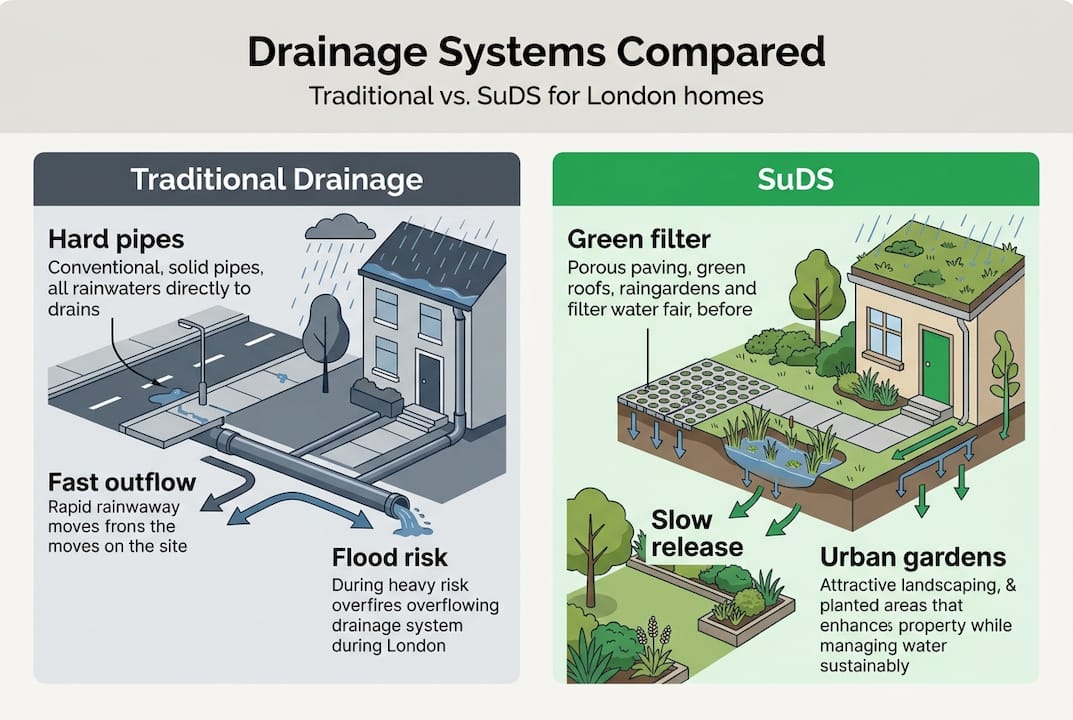
The regulatory picture in London is clear. Since 2015, Schedule 3 of the Flood and Water Management Act has required SuDS approval for new drainage systems in many circumstances. The Mayor of London’s drainage policies also encourage SuDS adoption across the capital. SuDS reduce flood risk by 50% and are 20 to 40% cheaper across their full lifecycle compared to traditional systems.
For property managers, this means that if you are planning any significant development or drainage upgrade, understanding SuDS is not optional. Here are the key steps to consider:
- Check whether your local planning authority requires a SuDS scheme for your project.
- Confirm whether your site conditions (soil type, groundwater level) support infiltration-based SuDS.
- Identify which SuDS components are appropriate: permeable paving, rain gardens, or attenuation tanks.
- Ensure your drainage contractor understands both traditional and SuDS design, as not all do.
Exploring effective drainage solutions early in any project can save considerable time and money when planning conditions are applied.
Understanding reports: Codes, surveys and decision-making
Receiving a CCTV survey report is often the moment when drainage terminology becomes most intimidating. These documents contain defect codes, invert measurements, pipe references, and condition grades that can look completely impenetrable.
The most widely used coding system in the UK is based on EN 13508-2, the European standard for inspecting and classifying drain and sewer defects. In the UK, this is implemented through MSCC5 (Manual of Sewer Condition Classification, 5th edition) and its successor, SRM (Sewer Rehabilitation Manual) coding. Artificial intelligence coding tools are now emerging that apply these standards automatically from CCTV footage, though human review remains standard practice.
Here is how to read a typical survey report in practical terms:
- Location references: Each defect is recorded with a distance from a manhole or access point. This tells you exactly where in the pipe the problem sits.
- Defect codes: Codes like BAJ (broken pipe, all around joint) or RIM (root intrusion, medium) describe what the camera found. Your contractor should translate these for you.
- Invert levels: These confirm whether the pipe gradient is correct and whether water can flow freely.
- Condition grades: Defects are graded by severity, typically from 1 (minor) to 5 (critical). Grade 4 and 5 defects usually require prompt action.
- Photographic evidence: Good survey reports include still images or video timestamps so you can see exactly what was found.
“A survey report without plain-English recommendations is only half a document. Always ask your contractor to tell you what the codes actually mean for your property.”
Pro Tip: When you receive a survey report, ask your contractor to walk you through each defect code and explain whether it requires immediate repair, monitoring, or no action. This single conversation can prevent thousands of pounds in unnecessary work.
Understanding the drain inspection process before the camera goes in the pipe means you will know what to expect in the report. Good drain maintenance guidance will also help you understand which defects are routine and which are genuinely urgent.
A property manager’s perspective: What most homeowners miss in drainage terminology
After working with hundreds of London property owners, we have noticed a consistent pattern. People focus on the most alarming words in a report, words like “collapse”, “fracture”, or “infiltration”, and either panic or dismiss everything else. Both reactions are costly.
The real skill in reading a drainage report is understanding context. A hairline crack in a secondary lateral pipe is not the same emergency as a structural collapse in a main sewer. Both might use frightening language, but the appropriate response is completely different.
What genuinely matters is the condition grade, the location of the defect, and whether it is getting worse. A defect that has been stable for years may need monitoring, not immediate repair. An apparently minor blockage near a property boundary, however, can escalate quickly if ignored.
We also see property managers lose money by not knowing what questions to ask. When you understand the terminology, you can challenge a quote that recommends full pipe replacement when relining would suffice. Working with local drainage specialists who explain their findings in plain English is not a luxury; it is simply good property management.
Get expert help decoding your drainage reports
Drainage reports and survey documents should never leave you guessing. If you are managing a London property and you have received a survey that raises more questions than answers, the right next step is a conversation with a drainage professional who will explain exactly what you are looking at.
RSJ Drains provides the full range of drainage services across Greater London, from routine inspections to emergency repairs. Our drain inspection services include detailed CCTV surveys with clear, plain-English reports so you always know what action is needed and why. Whether you need a CCTV drain survey to diagnose a problem or a second opinion on a confusing report, our team is ready to help. Call us any time, including outside business hours, for straightforward advice from engineers who know London’s drainage network inside out.
Frequently asked questions
What is the difference between SuDS and traditional drainage?
SuDS manage rainwater close to where it falls using natural methods such as permeable paving and rain gardens, while traditional drainage quickly pipes water to the sewer, which can increase flooding risk during heavy rainfall. SuDS mimic natural drainage and are now preferred for new developments in London.
What does ‘invert’ mean in a drainage report?
The invert is the lowest internal point of a drainpipe, used by engineers to measure flow gradients and assess whether water will drain correctly through the system.
Why should property owners care about EN 13508-2 codes?
These codes standardise how drain defects are reported across Europe, and EN 13508-2 codes defects to help owners understand which repairs are urgent and compare results between different survey providers.
How does understanding drainage terms help avoid extra costs?
When you understand what a contractor is describing, you can identify whether a recommended repair is genuinely necessary, compare quotes accurately, and avoid paying for work that exceeds what your drainage condition actually requires.
What should I ask my drainage contractor if I see confusing terms?
Ask for a plain-English explanation of each defect code and a clear recommendation for each finding, including whether action is urgent, routine, or simply worth monitoring over time.