
TL;DR:
- London property owners must ensure their drains meet legal standards for safe water discharge.
- Compliance involves understanding responsibilities between authorities, proper documentation, and following SuDS hierarchy.
- Proactive drainage management enhances property value, eases sales, and prevents costly enforcement actions.
Most London homeowners assume their drains just work quietly underground, someone else’s problem until something goes wrong. The reality is quite different. Drainage compliance is a growing legal and financial priority, particularly across Greater London, where councils, Thames Water, and the Environment Agency each play a role in enforcement. Get it wrong and you face blocked insurance claims, failed HMO licences, planning refusals, or expensive retrospective works. This guide cuts through the confusion, explaining exactly what compliance means, who enforces it, what documents you need, and how to avoid the pitfalls that catch property owners off guard.
Table of Contents
- What does drainage compliance mean in London?
- Understanding the drainage hierarchy and SuDS requirements
- Local rules, enforcement, and documentation in Greater London
- Practical scenarios: Upgrades, problems, and common pitfalls
- Our view: Why smart compliance is good for property value and peace of mind
- Get expert support for every step of drainage compliance
- Frequently asked questions
Key Takeaways
| Point | Details |
|---|---|
| Know your drainage responsibilities | Identify whether you or the water company is responsible for every section of your drainage. |
| Follow the drainage hierarchy | Use soakaways and SuDS before connecting to public sewers to meet compliance standards. |
| Document everything | Good records of drainage works and approvals simplify insurance, sales, and council checks. |
| Avoid costly shortcuts | Getting proper permissions and professional advice upfront prevents bigger legal and repair issues. |
What does drainage compliance mean in London?
Drainage compliance means your property meets the legal and technical standards for safely discharging both rainwater (surface water) and wastewater (foul water) into the wider drainage network. It sounds straightforward, but the reality involves multiple regulatory bodies, overlapping responsibilities, and property-specific rules that differ depending on your situation.
Three main bodies share enforcement duties in London:
- Local authorities (Lead Local Flood Authorities, or LLFAs): Your council is responsible for managing surface water flood risk and approving drainage designs for new development or significant changes.
- Thames Water: Responsible for public sewers and lateral drains. Understanding drainage terms explained is genuinely useful here because the line between a private drain and a public sewer is often misunderstood.
- Environment Agency: Steps in for higher-risk sites, major developments, or where drainage could affect watercourses and groundwater.
Your legal obligations also depend on the type of property you manage. Private homeowners are responsible for drains within their own boundary. HMO (Houses in Multiple Occupation) landlords face additional scrutiny because drainage conditions directly affect licensing. Blocks of flats managed by a freeholder or residents’ management company carry shared responsibilities that must be clearly documented.
Property boundaries matter enormously. Homeowners are responsible for private drains within their property boundaries, while Thames Water handles public sewers and lateral drains. That line, usually your boundary fence or wall, determines who pays and who is liable.
Documentation is not optional. If you ever make a claim on your buildings insurance, sell your property, apply for planning permission, or face a council enforcement notice, written records of drainage works and compliance checks become critical evidence. Insurers increasingly scrutinise drainage history.
Pro Tip: Before commissioning any drainage work, establish clearly whether the drain in question is private, shared, or public. Confusing these categories leads to wasted contractor costs and potential legal liability.
Understanding the drainage hierarchy and SuDS requirements
Not all drains are created equal, and legal standards govern what you can and cannot do with surface water. The official drainage hierarchy exists to reduce pressure on the combined sewer network, which in London is already under significant strain.
The hierarchy, from most preferred to last resort, works like this:
- Infiltration/soakaway: Allow rainwater to soak directly into the ground on your property. This is the ideal outcome and the first option councils expect you to consider.
- Watercourse: Discharge surface water to a local stream, ditch, or river with appropriate consent.
- Surface water sewer: Connect to a dedicated surface water sewer, separate from foul drainage.
- Combined sewer: The last resort, used only when no other option is feasible, and subject to Thames Water approval.
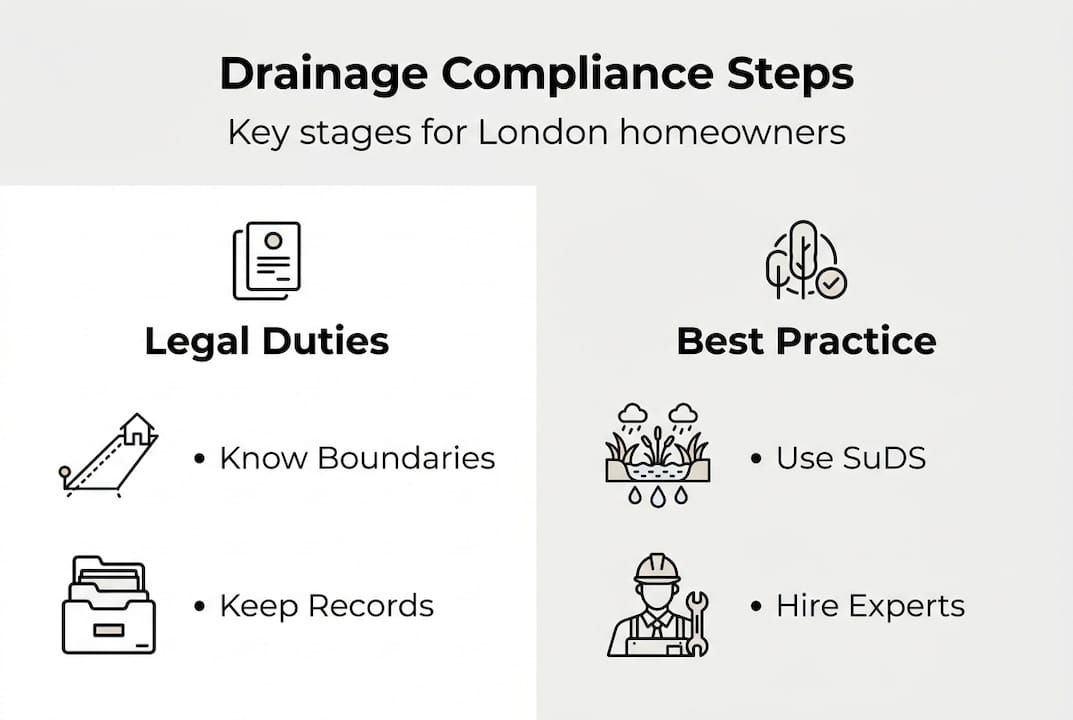
Surface water drainage follows a strict hierarchy, with national SuDS standards now required for new and retrofitted developments across England. SuDS stands for Sustainable Drainage Systems, and the term covers a wide range of techniques designed to manage rainfall more naturally.
| Drainage option | How it works | London example |
|---|---|---|
| Soakaway/infiltration | Water filters into the ground via a stone-filled pit | Common in outer London where soil allows |
| Rain garden | Planted depression holds and slowly releases water | Increasingly used in Westminster and Southwark |
| Permeable paving | Surface allows water through to sub-base | Driveways, car parks, retail areas |
| Green roof | Vegetation absorbs rainfall at source | Commercial buildings in central London |
| Combined sewer (last resort) | All flows mixed; volume restricted | Older inner London properties only |
The Westminster SuDS guidance gives a clear picture of how councils expect these options to be prioritised and evidenced.
To check which option applies to your property, follow these steps:
- Commission a site investigation to assess soil permeability (a simple infiltration test).
- Review your drain maintenance basics and identify existing drainage routes.
- Contact your LLFA to confirm which hierarchy tier your site permits.
- Use the drainage problem checklist to flag any existing issues before applying for consent.
- Submit a SuDS drainage strategy with your planning application or retrofit proposal.
“SuDS should be designed to limit the rate and volume of surface water run-off to a watercourse, sewer or other drainage system, and should improve water quality where possible.” — National Standards for Sustainable Drainage Systems
Local rules, enforcement, and documentation in Greater London
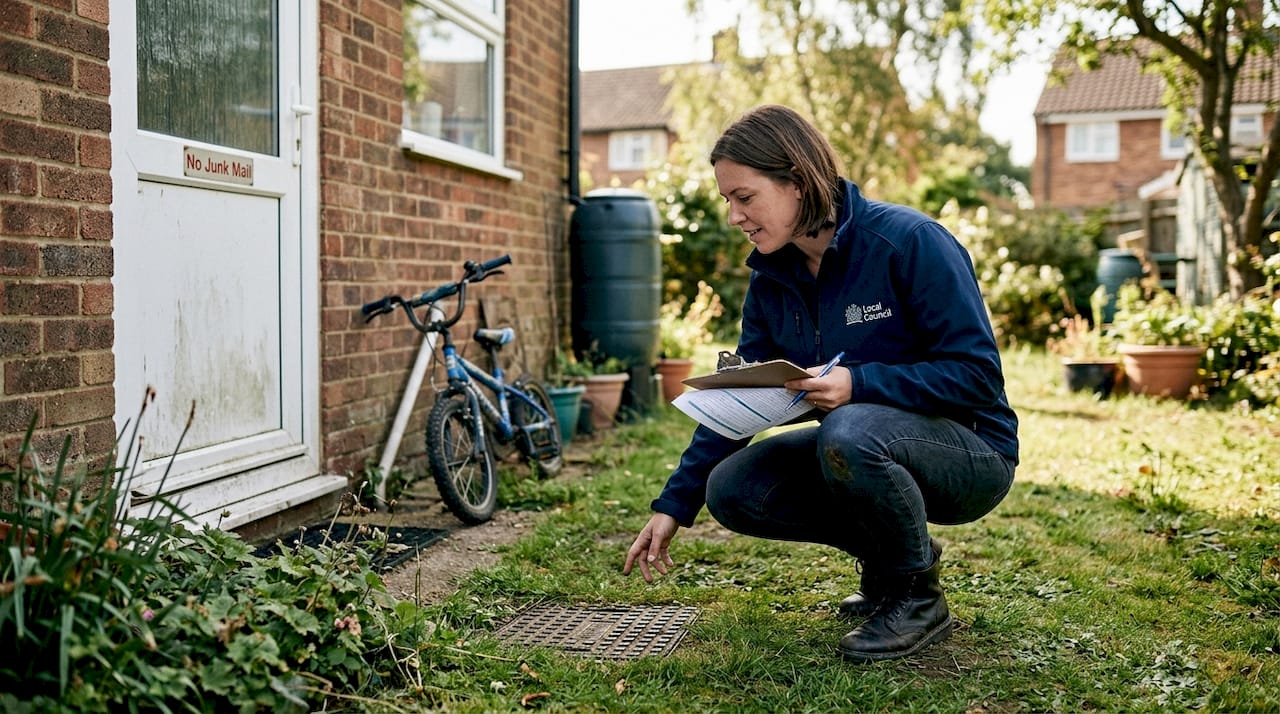
Adopting the national hierarchy is only the start. London boroughs add their own layer of requirements on top, and enforcement is real. Councils in London enforce SuDS and require detailed designs, including infiltration tests and maintenance plans, particularly for new builds and major extensions.
How this plays out varies by borough:
| Borough/body | Approach to SuDS enforcement | Key requirement |
|---|---|---|
| Westminster | Detailed design manual and pre-application advice | Infiltration test results mandatory |
| Southwark | Case-by-case review with SuDS appraisal | Maintenance plan required for approval |
| Barnet | LLFA conditions attached to planning consents | Attenuation calculations needed |
| Thames Water | Permissions and consents for connection or build-over | Written consent before any work starts |
For HMO landlords, drainage records directly affect licensing renewals. Councils checking HMO licence applications routinely look at whether drainage systems are maintained, tested, and compliant. A poorly documented drainage history can delay or block a licence.
Pro Tip: Save all drainage paperwork, whether paper or digital photographs, in a dedicated property file. When an insurance claim or council inspection arises, that evidence is the difference between a quick resolution and a protracted dispute.
Property managers overseeing blocks with shared drains must also coordinate with neighbours. Shared drainage is a common source of disputes precisely because responsibility is split. Drawing on local drainage expertise helps you navigate these grey areas without defaulting to costly legal action.
The paperwork you should keep includes:
- Original drainage design drawings and any amendments
- Infiltration test results and soil surveys
- Planning approvals and LLFA consent letters
- Records of all maintenance, jetting, or repair works
- CCTV survey reports with footage references
- Any Thames Water build-over agreements
Keeping this maintenance guide to hand makes staying on top of records far more manageable.
Practical scenarios: Upgrades, problems, and common pitfalls
Knowing the rules is one thing. Applying them to real London properties is where things get complicated. Practical challenges trip up even experienced landlords and property managers.
Common upgrade scenarios include retrofitting SuDS to an existing driveway, obtaining Thames Water consent to build an extension over a public sewer, or managing surface water at a site close to a watercourse. In dense urban London, SuDS like rain gardens and tree pits are preferred, but edge cases such as building over sewers or sites with high pollution risk require specialist solutions and consents rather than a simple retrofit.
The most common compliance mistakes London owners make:
- Starting work without consent: Assuming a drainage change is minor and skipping the approval process. Councils and Thames Water can require you to undo works at your expense.
- Ignoring shared drains: Failing to involve neighbours or the freeholder in shared drain issues, then being held liable when a blockage causes flooding downstream.
- Poor documentation: Completing works but keeping no records. This creates problems during property sales, insurance claims, and HMO licence renewals.
- Using a combined sewer by default: Not exploring higher-ranked options in the hierarchy before connecting to the foul/combined network.
- Misidentifying the drain type: Treating a lateral drain or public sewer as a private drain and attempting repairs that are Thames Water’s responsibility, or vice versa.
These money-saving maintenance tips help you stay ahead of routine issues before they escalate into compliance failures.
Pro Tip: Always obtain written council or Thames Water approval before major drainage work, even if a contractor tells you it is routine. Verbal assurances do not protect you from enforcement notices.
If you find yourself facing an unexpected drainage failure during or after works, emergency drainage advice is available around the clock, which matters when a compliance issue turns into a flooding event overnight.
Our view: Why smart compliance is good for property value and peace of mind
After seeing hundreds of London drainage cases up close, one pattern stands out clearly. The property owners who treat drainage as an afterthought almost always regret it. The conventional wisdom, that drains are out of sight and therefore out of mind, is genuinely costly thinking.
Proactive compliance is an investment, not a cost. Properties with strong drainage paper trails sell faster and more smoothly. Buyers’ solicitors now routinely ask about drainage history, and gaps create delays or price reductions. HMO landlords with documented maintenance programmes sail through licence renewals that trip up less prepared competitors.
London’s climate risk is real and rising. Heavier rainfall, urban heat, and ageing infrastructure mean enforcement is increasing, not decreasing. Corners cut today become expensive rectification works tomorrow, often at the worst possible time.
The clients who sleep best are the ones who asked about compliance before they had a problem. Getting a professional drainage service involved early, rather than after a crisis, is simply the smarter move for any London property owner or manager.
Get expert support for every step of drainage compliance
Understanding the regulations is the first step. Acting on them is where RSJ Drains can make a real difference for your property.
Our CCTV drain survey service gives you a clear, documented picture of your drainage system’s condition, which is exactly what councils, insurers, and solicitors ask for. From there, our drain inspection services identify any compliance gaps before they become enforcement issues. Need an ongoing plan? Our practical maintenance guide helps you build the documentation record that protects your property long term. We work across Greater London with fast response times and a family-run approach that puts your interests first.
Frequently asked questions
Who is responsible for maintaining my drains in London?
You are responsible for private drains within your property boundary, while Thames Water manages public sewers and lateral drains beyond your fence. The boundary fence or wall is usually the dividing line.
What are SuDS and why do I need them?
SuDS are Sustainable Drainage Systems designed to manage rainfall naturally, reduce flooding, and limit pollution. National SuDS Standards require SuDS for new developments and major retrofits, making them a London planning priority.
What documents should I keep for drainage compliance?
Keep design drawings, infiltration test results, planning approvals, maintenance records, and CCTV survey reports. Documentation supports insurance and HMO licence compliance, and gaps cause real problems during sales or claims.
Do I need council approval for drainage changes?
Major drainage changes almost always require council or Thames Water consent, particularly for SuDS retrofits or build-over agreements. Always check before works begin, regardless of what a contractor advises.
Recommended
- Drain Maintenance Explained: Protecting London Homes
- Drain Maintenance Guide for London Homes and Properties
- Emergency Drainage Services – Safeguarding London Homes
- Drainage industry terms explained for London property owners
- Drain Surveys London | CCTV Drainage Inspections & Reports – Pest Control 24 London